Showing posts with label Guardian Top 100 Women. Show all posts

Wednesday, October 19, 2011

Hawa Abdi - Guardian Top 100 Women Science and Medicine


The Guardian

One of Somalia's first female gynaecologists, Hawa Abdi now uses her own money to run a small hospital treating everything from war injuries to malnutrition and disease


Dr Hawa Abdi. Photograph: Martin Roe/Retna Ltd.

In 1983 Abdi, one of Somalia's first female gynaecologists, opened a small clinic for women and children on her family farm. When the country descended into civil war in 1991 she opened to all and now the camp near Mogadishu is home to around 90,000 people. , mostly displaced women and children seeking refuge and treatment for everything from war injuries to malnutrition and disease.

When Islamist militants invaded the camp, they took Abdi hostage for a week, saying women should not be allowed to be in control of such a place. "I may be a woman, but I'm a doctor," she said. "What have you done for society?"

As aid agencies have abandoned the dangerous country, Abdi runs her small hospital, often with the help of her daughters Deqo and Amina, who are also doctors, on her own savings and donations. She also helps provide food and clean water, runs a school and literacy classes for women and campaigns against female genital mutilation. This woman, with her education and one-time family wealth, could easily have left her lawless country but she chose to stay: "We women in Somalia are trying to be leaders in our community."

Friday, October 7, 2011

Carol Ann Duffy - Guardian Top 100 Women - Writing and Academia


First tipped for the job 10 years earlier, she finally became the first female poet laureate in 2009


Carol Ann Duffy. Photograph: Murdo Macleod for the Guardian

The first female poet laureate, Carol Ann Duffy, 55, was first touted for the job in 1999, but was reluctant because of her status as a mother in a lesbian relationship. Ten years later she accepted, but insisted it was a prize for other women, saying: "I look on it as recognition of the great women poets we now have writing."

It was certainly a long-awaited acknowledgement – the first woman to be considered for the laureate, Elizabeth Barrett Browning, was overlooked for Alfred Lord Tennyson. And after his death, rather than award it to Christina Rossetti, the position was left vacant until Alfred Austin was appointed. Yet it seems fitting the first woman would be Duffy, not just critically acclaimed, but loved for her witty ways of filling the gaps left by women's silences in her collection, The World's Wife, which saw every poem told in the voice of a wife of a great historical figure, and Feminine Gospels.

Wednesday, September 21, 2011

Maya Angelou - Guardian Top 100 Women - Writing and Academia


Writer, academic and activist, who chronicled the African American experience in literature


Maya Angelou. Photograph: Gerald Herbert/Associated Press

When she started to chronicle the African-American experience through her own life, Maya Angelou, 82, had a lot to work with – enough to fill six books of autobiography, the first of which was the longest-running non-fiction paperback on the New York Times bestseller list.

A friend and supporter of Malcolm X and Martin Luther King, as well as being Oprah Winfrey's mentor, it is her willingness to share the wisdom she gained from the struggle of her early years that inspires her generations of fans.

As a child she was raped by her mother's boyfriend. When her attacker was kicked to death she didn't speak for five years – believing that by naming him she had killed him. After becoming a teenage mother, a professional dancer, prostitute, playwright, television producer, film director and lecturer, one of her volumes of poetry was nominated for a Pulitzer prize and she was asked to read at Bill Clinton's inauguration. As one reader said: "When I was a teenager her books opened up a world to me that made me consider who I was as a person and who I wanted to be. Her writing showed me that I could do or be whatever I wanted because of - rather than despite – my gender."

Monday, August 22, 2011

Xinran Guardian's Series: Top 100 women: Art, Film, Music, Fashion


The Guardian


Xinran, the author who started off as a Chinese radio agony aunt. Photograph: Martin Argles for the Guardian

In 1989, she started presenting her radio show, Words on the Night Breeze, China's first agony aunt programme. Thousands of women contacted her to tell their stories, and for the first time women's voices and experiences were being heard – they told of rape, incest, violence and childhood abuse. "I discovered that women had no idea how to talk about themselves. In family tradition, in education, in society, even if you asked them, women had never talked about what happened in their own lives." The programmed turned Xinran into a successful broadcaster, but she felt constrained by the state and the demands of her job. She spent two years travelling around China, listening to the stories of more women, before leaving for the UK in 1997, where she worked as a cleaner and a waitress while she learned English. Her book, based on her research, the Good Women of China, was published in 2002 to acclaim, and she continues to write about women's stories. Xinran also set up a charity Mother Bridge of Love, to support British families who have adopted children, mainly girls, from China.

Monday, July 25, 2011

Margaret Chan Guardian's Series: Top 100 women: activists and campaigners


Director of the World Health Organisation, battling international viruses, and championing improvements in all of our most pressing diseases


Margaret Chan, director of the World Health Organisation. Photograph: Fabrice Coffrini/AFP/Getty Images

Margaret Chan, 64, has been on the frontline of the global fight against swine flu, Sars and bird flu – and is now said to be the most powerful international public health official in history.

Originally a teacher, she trained as a doctor in Canada before returning to Hong Kong and heading the health department – just in time to have to deal with an outbreak of bird flu. After initially trying to reassure people chicken was safe to eat, she ordered a cull of all 1.5 million ducks and chicken in the country – and her decision was seen as crucial in stopping the virus. She was also at the helm when Sars hit, and while she was criticised for what was seen as a slow response, the then director general of the WHO was so impressed that he headhunted her. saying, "You are the only person who has managed crises. I have many armchair experts. I need generals."

As well as battling international viruses, she is also trying to champion improvements in maternal care, HIV and Aids care, malaria, and all of our most pressing diseases. When she was made director in 2006 she was clear about her priorities: "What matters most to me is people. And two specific groups of people in particular. I want us to be judged by the impact we have on the health of the people of Africa, and the health of women."

However it was not long before she has to turn her attention again to global viruses. In June 2009 she became the first WHO chief in 41 years to announce a worldwide pandemic when swine flu swept across the globe. This time around critics complained the public health expert had overreacted. The Council of Europe accused the WHO of having "gambled away" public confidence by overstating the dangers of the flu pandemic, in a draft report. But Chan is unrepentent, firmly stating,"That was the right call," - and in the UK at least the response to the pandemic was proportionate and effective, according to an independent review.

Wednesday, July 13, 2011

Oprah Winfrey - Guardian's Top 100 Women - Entertainment


http://www.guardian.co.uk


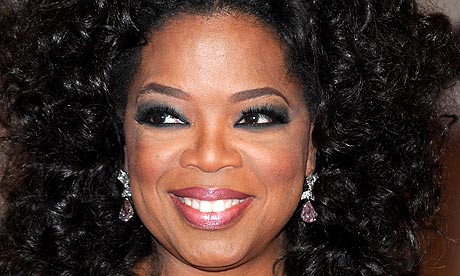
Oprah Winfrey

The talk show host, actress and philanthropist is not satisfied with having conquered the US and is now taking on the whole world

    Oprah Winfrey
    Oprah Winfrey. Photograph: Evan Agostini/AP

    Being black and a woman has not stopped Oprah Winfrey becoming one of the most powerful people in the world and her claim to influence lies on stronger foundations than her ability to get stars such as Tom Cruise over-sharing on her couch.

    The importance of an appearance on her talkshow was underlined when the then President-elect Barack Obama was a guest – it was seen as providing a boost to his profile not hers.

    She rose to become the world's first black female self-made billionaire from a childhood so poor it sounds like a punchline for a joke – she adopted two cockroaches as pets and wore sackcloth as her grandmother could not afford to buy her clothes.

    Her willingness to talk about her years of being sexually abused, her teenage pregnancy and the loss of her baby, her constant battle with her weight and childhood poverty have made her a hero to millions of viewers around the world.

    Her endorsements can make careers (books she mentions routinely become bestsellers) and she doesn't always pick perfectly (Jenny McCarthy appeared on her show to explain why she thinks vaccination caused her son's autism), but her support for gay rights, Aids awareness, sexual abuse victims and literacy campaigns are impressive and consistent.

    As is her philanthropy: she founded a school in South Africa, Oprah's Angel Network, which gives educational grants, and personally donated $10m to rebuild homes after Hurricane Katrina.

    At 57, she's hardly self-effacing – her latest venture is her own television channel to add to a magazine called O, The Oprah Magazine – but few have done as much to put women, poor black ones at that, on the international map.

Monday, July 4, 2011

Aung San Suu Kyi - Guardian's Top 100 Women - Politics


http://www.guardian.co.uk


The Burmese pro-democracy leader who has inspired the world with her non-violent resistance to a brutal dictatorship

by Sarah Brown

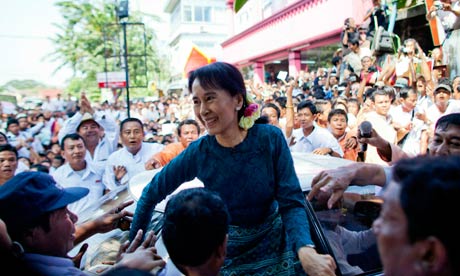
Aung San Suu Kyi in Yangon, Burma, November 2010
Aung San Suu Kyi. Photograph: Getty Images

Burma's pro-democracy leader Aung San Suu Kyi for me embodies one of life's most important lessons; you don't need to be fierce to be strong.

Throughout decades of humiliation, a long imprisonment and searing severance from her husband and children, the woman the Burmese affectionately call "Daw Suu" an honorific title given to revered women, has inspired the world with her campaign of non-violent resistance to one of the most brutal dictatorships the world has known. The courage to face down the military regime has come from her belief that, in the end, no junta is stronger than a people's yearning to be free.

Read More

Friday, June 17, 2011

The Guardian's Top 100 Women


http://www.guardian.co.uk


They have led countries, broken through glass ceilings and even been in space ...


  • Top 100 women by category

  • Nawal El Saadawi Nawal El Saadawi: Egyptian doctor, psychiatrist, feminist, university lecturer and writer
  • Lady Gaga egg grammys Lady Gaga: Outlandish dresser, performer and politicised pop icon for the Twitter generation
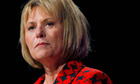
  • Yahoo CEO Carol Bartz speaks during conference in San Francisco Carol Bartz: The first female CEO of a major software company, Yahoo
  • Law

    Lawyer Gareth Pierce Gareth Peirce: Lawyer whose battles against miscarriages of justice have changed legal history
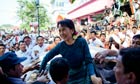
  • Aung San Suu Kyi in Yangon, Burma, November 2010 Aung San Suu Kyi: The Burmese pro-democracy leader who has inspired the world with her non-violent resistance to a brutal dictatorship
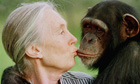
  • KISSING TESS Jane Goodall: Primatologist and environmental campaigner, who has conducted groundbreaking work on chimpanzees
  • caster semenya top 100 women Caster Semenya: Young athlete who overcame global gender taunts to win world championship
  • martha lane fox 100 women Martha Lane Fox: Entrepreneur who founded lastminute.com and is leading the government's campaign to get people online
  • Oprah Winfrey Oprah Winfrey: The talkshow host, actress and philanthropist - not satisfied with conquering the US - is taking on the whole world
  • Doris Lessing novelist top 100 women Doris Lessing: Nobel prize-winning novelist, celebrated for writing a pioneering work of female emancipation